"COLDRERIO GREEN STOP" CONSORTIUM
TECHNICAL REALIZATION
ARCHITECT CLAUDIO LO RISO
PREMISE:
Fight against smog without borders
Lombardy to the south, German-speaking Switzerland to the north. In the center of Ticino. An obligatory passage, a bridge between two shores of Europe, Switzerland is one of the cantons most affected by air pollution.
Ozone in the summer, fine dust in the winter. In short, depending on the weather conditions, Ticino has to deal with situations that also require emergency measures.
Measures loudly requested by environmentalists, according to which the commitment to improve the air we breathe must be strengthened by all means. The alarm raised in Paris during the presentation of the climate report by the UN confirms that the health of Planet Earth is far from in good condition.
Motor vehicles have a major impact on both air quality and climate, as they are responsible for the emission of various pollutants. It is estimated that in Ticino traffic generates 78% of the nitrogen oxides present in the atmosphere and 33% of fine dust.
(extract from swissinfo, Françoise Gehring, Milan and Bellinzona)
Municipality of Coldrerio
The priorities for the protection of the environment and the territory are to combat climate change, preserve biodiversity and reduce the problems caused by pollution.
The Municipality of Coldrerio is very attentive in this area and organizes days to raise awareness among the population.
(Excerpt from the home page of the municipality of Coldrerio)
BUILD A SERVICE AREA TODAY:
Faced with the national and global impact that the automotive and construction sectors have on the environment, I believe that building a new service area today means dealing with all these problems related to pollution and energy consumption, trying to affect the weak ecosystem as little as possible.
Demonstrating that it is possible to create eco-compatible projects even in paradoxical situations such as that of a service area, not only means revealing one's sensitivity towards environmental issues, but also means laying the foundations so that the new standards and new environmental protection regulations.
The diffusion of these practices will also lead to the development of technologies for the environment that are increasingly within everyone's reach, reducing the gap that currently exists between the costs applicable to the construction of an eco-compatible building compared to those of a "normal" building.
This highly innovative approach is even more important if it is considered for a service area owned by the Canton of Ticino.
THE PROJECT:
The idea behind the new Coldrerio service area is to create a service area that is sustainable from every point of view.
“the first ecological service area in the world”.
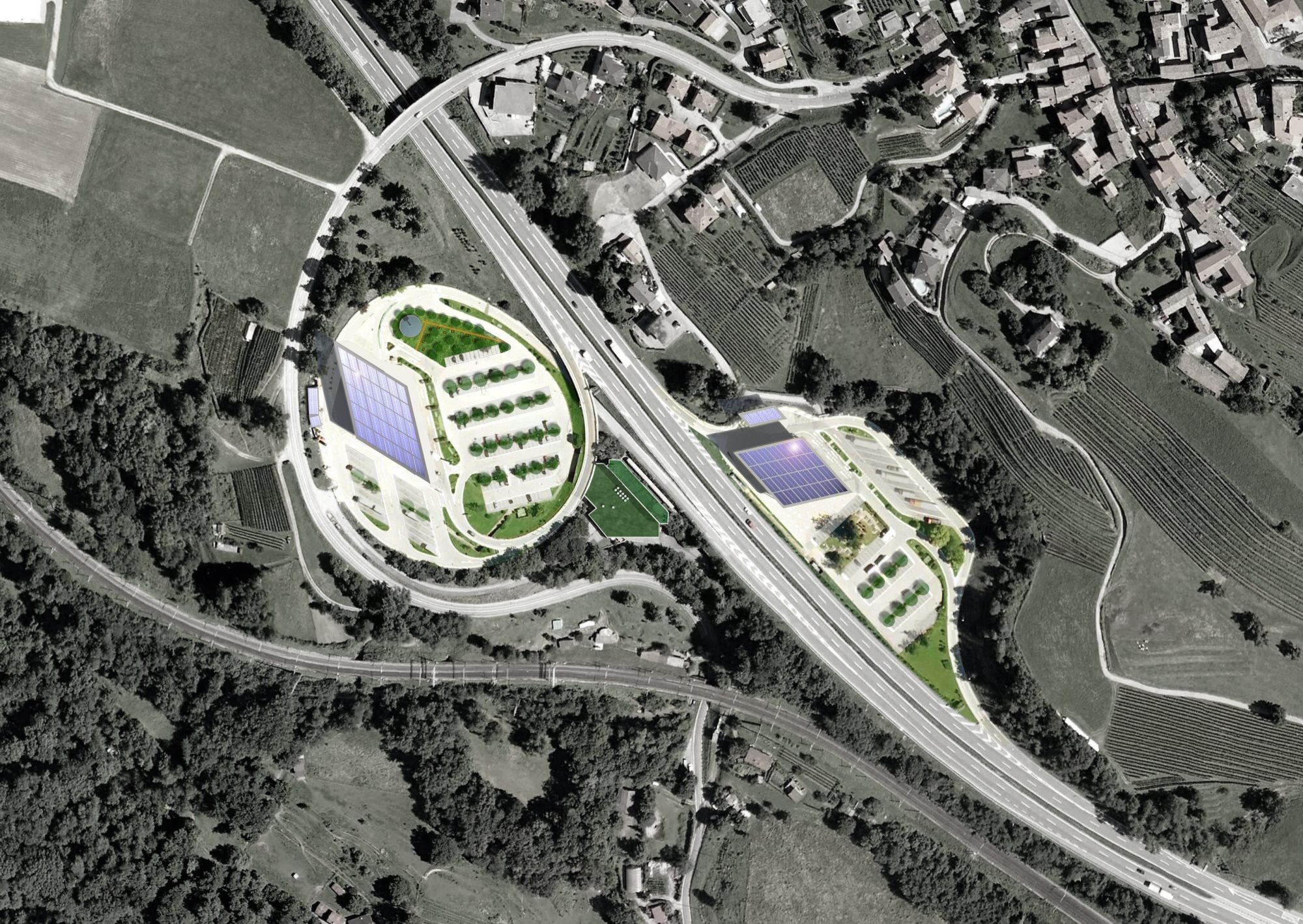
The project takes shape from a general analysis of the context and the elements that characterize it, elements that have been taken up in order to best adapt the new buildings to the "permitted" areas, without modifying the circulation of cars, heavy vehicles and respective fuel delivery pumps.
The project therefore envisages the total demolition of the two existing service areas and the restructuring of the Motel, again with eco-compatible principles.
The bidder intends to create a service area totally independent from fossil energy sources and with a production of electricity sufficient to cover its needs, almost a "small" power plant, built with 5 ecological principles:
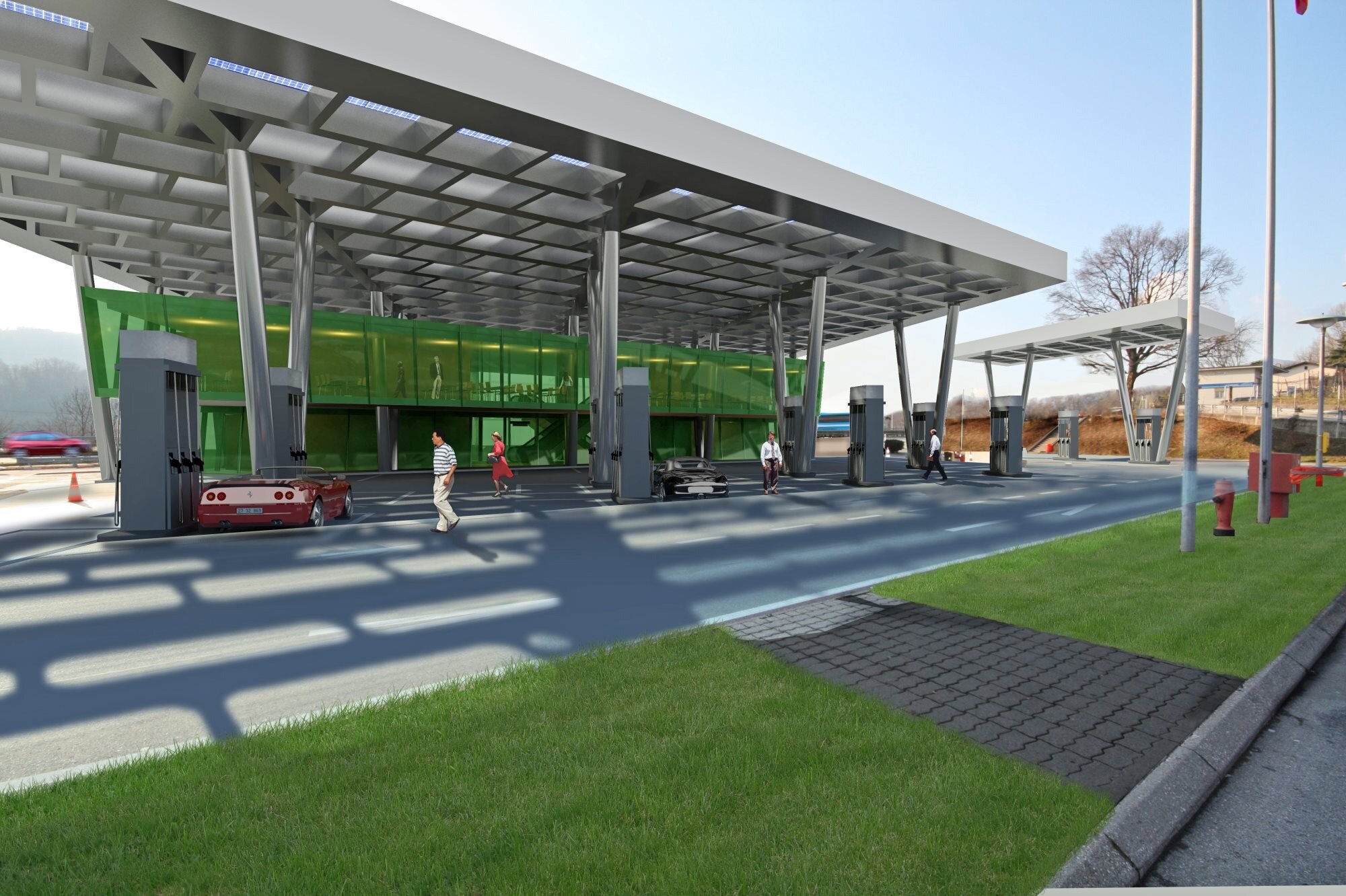
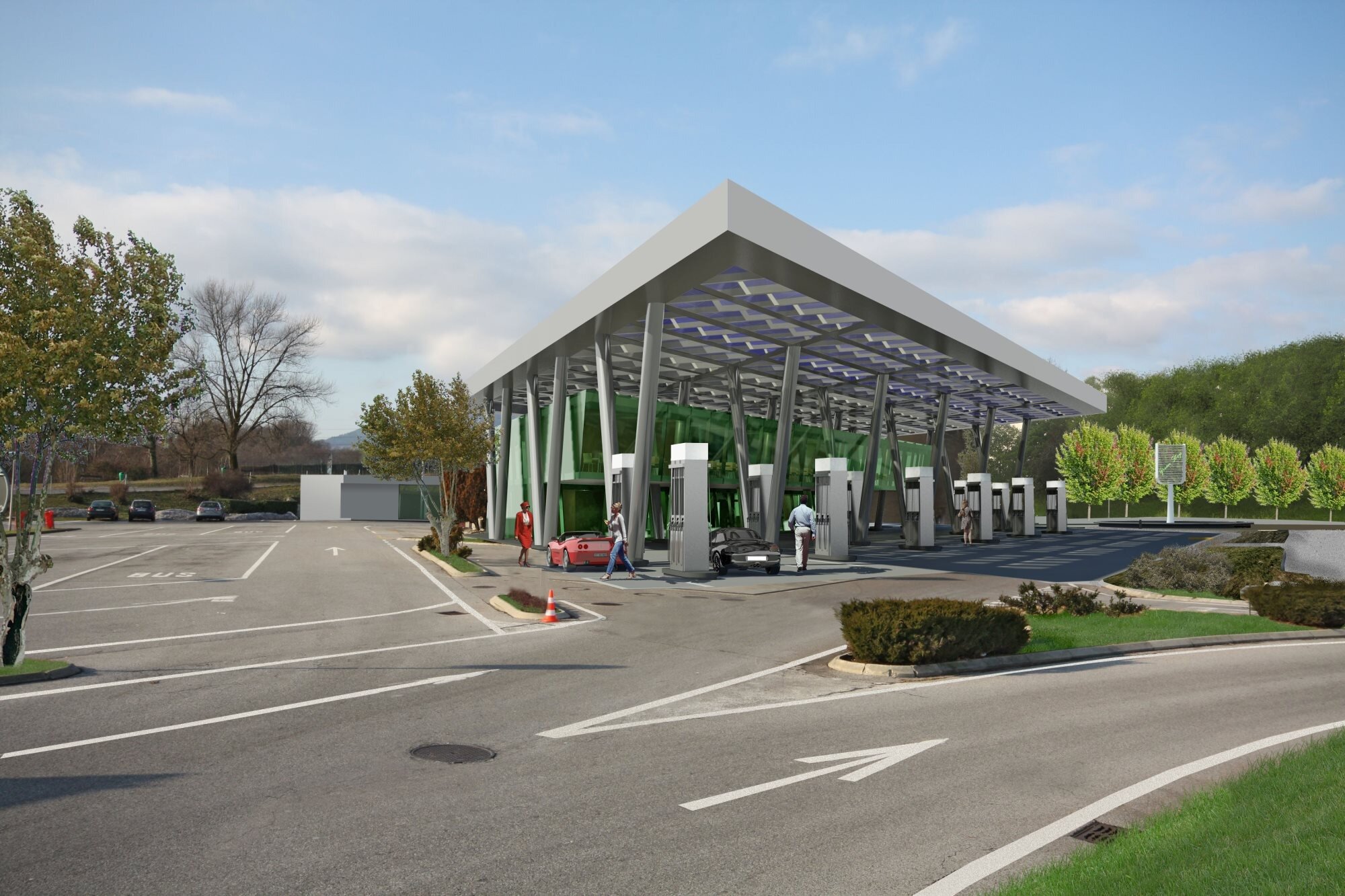
- Two large steel sheds of approx. 2500 square meters covered by photovoltaic panels to produce electricity.
- Buildings built with recyclable, sustainable materials, according to the Minergie standard, with heating and cooling by heat pump with geothermal probes, exploiting the thermal inertia of the ground.
- Intelligent roof, ventilated, with rainwater recovery, also used to irrigate the vegetation and green areas of the service area.
- Laying of artificial trees "eats pollution" and planting of natural trees.
- Lighting and technologies with low energy consumption.
Each element of the construction contributes to the creation of a dynamic, rational structure, capable of making the building efficient from a bioclimatic point of view and therefore optimizing energy savings.
Therefore a highly technological and eco-compatible project to promote an image of Switzerland and the Canton of Ticino that is sensitive to environmental issues.
1. THE TWO BIG CANOPIES
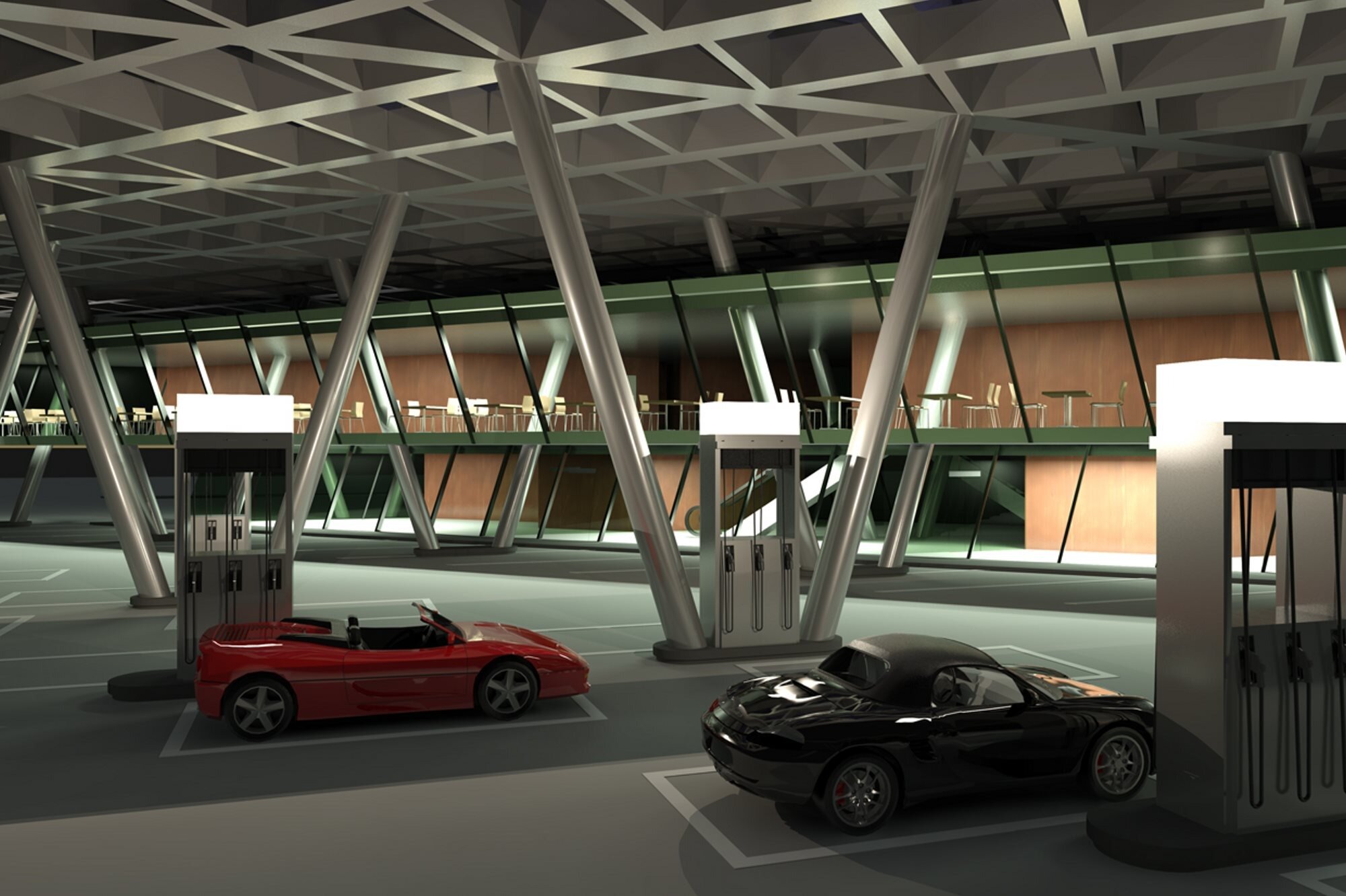
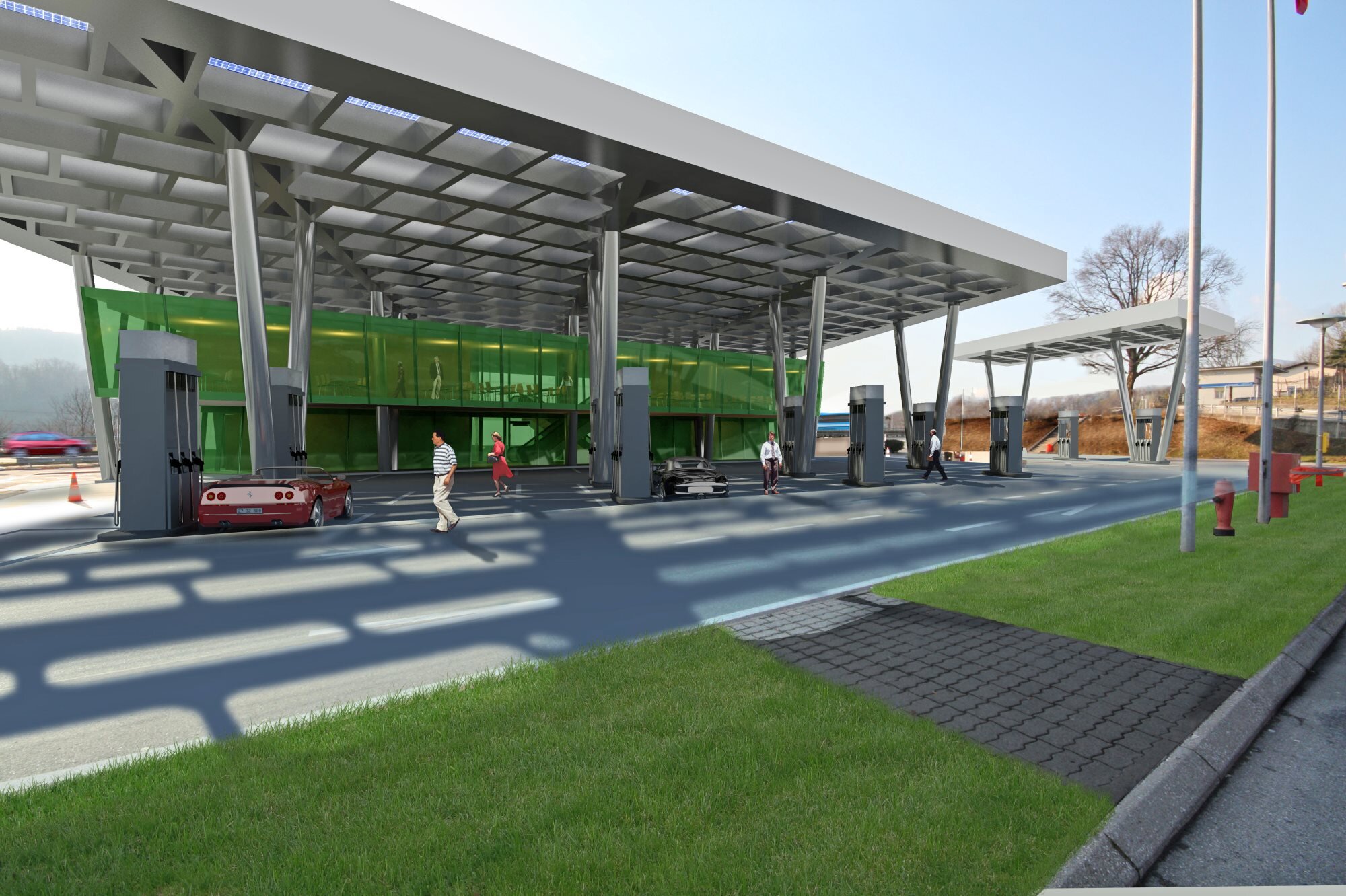
The two large canopies of the north and south stations are designed in steel and have the function of creating the place of arrival for motorists where they can refuel protected from the elements.
Furthermore, the roof is designed with polycrystalline silicon photovoltaic panels with double tempered glass, integrated into the metal structure of the roof to produce electricity.
Electricity production through polycrystalline photovoltaic panels:
- 2500 square meters produce about 270,000 kWh / year
CO2 savings:
- savings = about 100 tons of CO2 (per year for 2500 m2 of photovoltaic panels)
2. NORTH STATION-SOUTH STATION
Due to their position, the two Coldrerio service areas of the Chiasso – San Gottardo motorway assume strategic importance both for entering and leaving Italy, and for the image they leave to visitors.
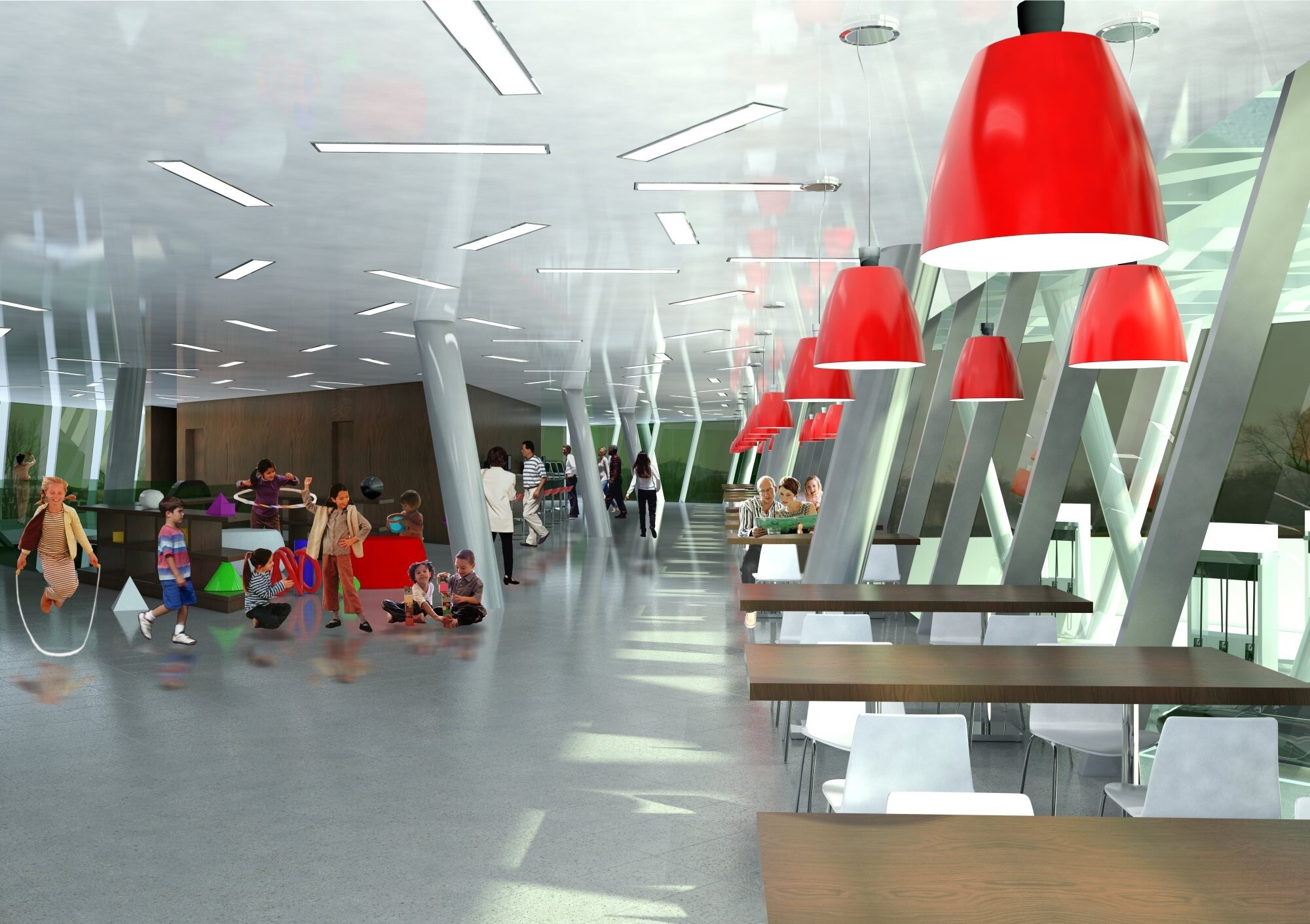
The idea is to build service stations that offer ample opportunity to relax in a large open space on three floors.
At the entrance to the station, we discover two escalators with a fountain, open shops, an infirmary and free circulation which leads easily to the first floor where there are other open shops, the self-service restaurant, a children's play area, an internet-cafe and other services. In the basement there are the technical rooms, storerooms for shops, services with showers and changing rooms for users and staff.
An arrangement of spaces that guarantees the right lighting and adequate ease of movement on all routes, making the building more easily accessible and recognizable by users, with two escalators on the ground floor and an elevator with a staircase that allows access at all three levels.
Glass, wood and steel are the three dominant materials of the project, which offer a light and transparent space, easy to use, comfortable for shopping and relaxing for an "ecological" break.
In fact, an electronic sign placed at the entrance to the building will indicate the daily production of electricity and will briefly explain the functioning of the photovoltaic panels and the construction in general, while the multipurpose room envisaged inside the Motel could be used for conferences, conferences and exhibitions on the environmental theme.
3. INTELLIGENT COVERAGE
The covers of the two service stations therefore have a triple function:
- protect from bad weather
- produce electricity
- rainwater recovery
The recovery of rainwater is another important point of this project which provides collection channels on the roof which are introduced into two large underground tanks, to then use the water both for irrigation of the vegetation and for toilet flushing .
4. LAYING ARTIFICIAL AND NATURAL TREES
The project involves the installation of two artificial trees along the north and south highways at the entrance to the respective service stations.
In fact, the prototype of a current artificial tree is as big as a shipping container and can remove carbon dioxide from the atmosphere thousands of times more efficiently than the same volume of plants.
A mass-produced artificial tree costs around $20,000 and could currently absorb one ton of CO2 per day (savings = 365 tonnes of CO2 per year for each artificial tree).
We realize that this is an experimental and pioneering product, but for this very reason I believe it should be part of this project which also aspires to become a place for experimentation and research in the fight against environmental pollution.
We also intend to place more natural trees on the North and South station parking spaces, both to shade the square and reduce the overheating of the asphalt in the summer months, and because these plants have a large leaf surface and can contain air pollution by acting as a filter for fine dust and gases, releasing a relatively low amount of volatile substances into the air.
5. LIGHTING AND LOW ENERGY CONSUMPTION TECHNOLOGIES
LED technology will certainly represent the future of lighting as it can guarantee numerous advantages:
- With the same brightness performance, LEDs consume less energy and are therefore suitable for low energy consumption solutions.
- decrease in the amount of "material" used for their production; compared to traditional products it therefore entails a reduction in size and weight, resulting in a facilitation in the procurement, storage and transport of materials and in industrial production
- reduced content of toxic or harmful substances; the component parts of the LEDs are easily disaggregated, disposable and recyclable (at the same level as the normal diodes used in electronics)
- reduced or no emission of UV and IR rays
- long average life span
- constantly evolving technology
- very low maintenance, almost non-existent
- operation up to 150,000 hours (level L70, not perceptible to the human eye).
- universality of use
The concept of LED lighting can be applied in all internal and external areas, because there is a great variety of powers and applications that allow their introduction in every area.
6. THE MOTEL
The existing Motel building will be maintained and remodeled with a small extension to create a multi-purpose room towards the garden southwest of the Motel.
This multipurpose room can be divided into two areas depending on the needs and will be used both by the restaurant and for conferences, exhibitions and educational meetings on the theme of the environment.
The renovation plans to create a ventilated facade with a cladding of 100x100 cm aluminum panels and to thermally insulate the facades and the roof.
The roof of the ground floor and of the bedrooms will also be covered with a layer of special vegetable earth which allows for the creation of a green roof just 10 cm thick directly on the waterproofing layer. So a green roof without rainwater containment tanks and without creating excessive additional costs.
The advantages are enormous and range from the simple improvement and protection of thermal and sound insulation, up to urban planning aspects (gaining green spaces), ecological aspects (air cooling and oxygen production) and architectural aspects (enhancement of the building).
7. LOW ENVIRONMENTAL IMPACT FUELS
The need to satisfy customers with an increasingly vast range of fuels designed to reduce the environmental impact deriving from urban traffic is another point that the bidder intends to develop with a station capable of dispensing conventional fuels as well as petrol low aromatic content and sulfur-free diesels that already have characteristics of strong environmental value, including gaseous fuels such as methane, LPG and AdBlue, the new product for the trucks of the future. In addition, special parking spaces will also be studied for refueling electric cars.
A station therefore where respect for the environment is worth double: for the products it supplies and for the solar energy it generates, to demonstrate the feasibility and sustainability of building a complex, integrated station, oriented towards low environmental impact mobility .